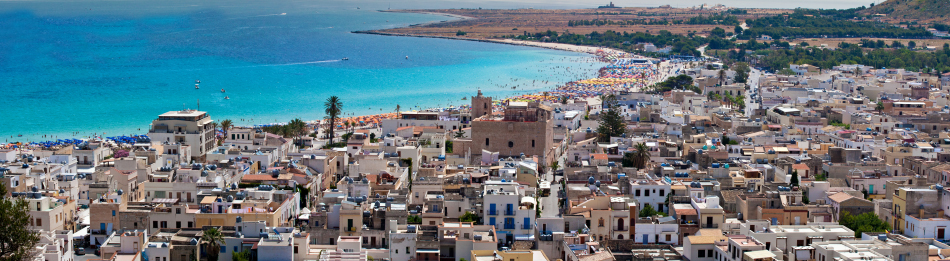
Best Beaches Egadi Islands: The Western Mediterranean's Clearest Water, 25km from Trapani
The 241 BC Battle of the Egadi Islands (the Battaglie delle Egadi, the naval battle between the Roman fleet and the Carthaginian fleet in the Sicilian Channel west of Favignana) ended the First Punic War and established Rome as the dominant Mediterranean naval power. The sea floor between Favignana and Levanzo holds the most extraordinary Roman and Carthaginian naval archaeological deposit in the world. 19 bronze ship rams (rostra) recovered from the seabed since 2004, now in the Museo Regionale A. Pepoli in Trapani. You swim in this water. It is remarkably unaware of its own history.
Compare the same experience on GetYourGuide and Viator, save what you like to My Trip, share it, and book when you’re sure. Nearest to this page first.
Water like glass
Favignana & Egadi boat day
Bike-flat island, butterfly-shaped, water like glass, boat day from Trapani.
The Isole Egadi (the Egadi archipelago. 3 main islands, Favignana, Levanzo, and Marettimo, plus 2 uninhabited rocky outcrops, Formica and Maraone) are located in the Sicilian Channel 25–37km west of Trapani. The islands are part of the Riserva Naturale Marina delle Isole Egadi (the Egadi Marine Reserve, established 1991, the largest marine protected area in the Mediterranean, 53,992 hectares covering the three islands and the surrounding sea). The marine reserve classification (the core zones. Zone A, absolute protection, no anchoring, no fishing. Zone B, restricted activity. Zone C, limited tourism) creates the conditions for the exceptional water clarity and the marine biodiversity that makes the Egadi the finest diving destination in western Sicily. The specific water clarity reason: the Egadi are surrounded by deep open Mediterranean water (50–200m within 500m of the island coastlines), completely isolated from the Sicilian mainland river systems that produce coastal sediment. The combination of deep water and the 2–3 knot current through the Sicilian Channel produces constant water exchange, the Egadi Islands sea water is essentially open Mediterranean water, not coastal Mediterranean water.
Ferry access from Trapani: the Egadi Islands are the most accessible Sicilian island group. Siremar and Liberty Lines operate the most frequent service in Italy for an island group this remote. Favignana: 30 minutes by hydrofoil (aliscafo, €17 each way, 10+ daily in summer), 70 minutes by ferry (€9 each way, 5–6 daily). Levanzo: 35 minutes by hydrofoil (€17), 90 minutes by ferry (€9). Marettimo: 1 hour 15 minutes by hydrofoil (€22), 2 hours 45 minutes by slow ferry (€11). Liberty Lines and Siremar tickets at the Trapani Molo di Sanità embarkation point (adjacent to the Trapani historic center, 5 minutes' walk from the station). Day trip logistics: Favignana is the most practical day trip from Trapani. Marettimo requires an overnight stay to experience the island properly.
Cala Rossa: The Quarry That Became a Beach: Cala Rossa (the Red Cove, on the northeast coast of Favignana, accessible by bicycle from the Favignana port in 15 minutes or by the boat tour from the port in 5 minutes) is the most visually extraordinary Italian beach: a former tufa stone quarry (the Favignana calcarenite, the specific golden-yellow limestone that was quarried from the island from Roman times to the 1980s, used as a building stone across Trapani province, the last quarry operations ceased in the late 1980s) has been flooded by the Mediterranean to produce a swimming environment where the precise geometric cuts of the quarry walls (the drilling marks, the step-cut faces, the tool marks in the stone) descend directly into 1–8m of clear water, the stone golden-yellow below the surface turning blue-green in depth. The quarry geometry (the right-angle cuts, the flat-cut floors, the vertical walls with tool marks) produces an entirely artificial-looking swimming environment that is simultaneously geological and archaeological, you swim inside a 2,000-year-old stone extraction system. The tufa cut by Roman builders to construct Trapani is below your feet at 3m depth. The water color: the golden tufa floor producing amber-green reflections at 1–2m depth, transitioning to clear blue at 5m. No sand, no pebble, pure carved limestone.
favignana, isole egadi, sicily, · photo roberto from italy · CC BY 2.0 · via Wikimedia Commons
Favignana: The Butterfly Island and the Tuna Slaughter
Favignana (the largest Egadi island. 19 km², population 4,000, the butterfly shape visible from above, the island's two promontories give it the silhouette that produced its nickname, l'Isola Farfalla) is the most historically documented tuna fishing island in Italy. The mattanza (the traditional bluefin tuna trap-and-slaughter, the millennia-old Sicilian and Sardinian tuna hunting technique, using a series of progressively smaller net chambers to concentrate the migrating bluefin tuna into the final "chamber of death" where they are killed with hand gaffs in a ritual that combines technique, tradition, and extraordinary violence) was practiced at Favignana until 2007, when the collapse of the bluefin tuna stock in the Mediterranean ended the commercial viability. The Stabilimento Florio (the 19th-century Florio family tuna cannery at the Favignana port, the most elaborately engineered food production building in Sicily, built by Vincenzo Florio in 1859, the most powerful Sicilian business family of the 19th century. Now the Museo del Mare, €4, open daily 9am–6pm in summer) documents the mattanza tradition with the original equipment, the net fragments, and the specific photographic record of the last mattanza decades. The 2007 closure of the Favignana mattanza is the most precisely documented extinction event in Italian food culture: the specific fishermen, the specific technique, the specific sea, all documented in film and photograph within living memory.
How do you get to the Egadi Islands?
The Egadi Islands are accessible by ferry and hydrofoil from Trapani: Favignana (30 minutes hydrofoil €17 / 70 minutes ferry €9, 10+ daily departures summer). Levanzo (35 minutes hydrofoil €17 / 90 minutes ferry €9, fewer departures). Marettimo (75 minutes hydrofoil €22 / 165 minutes ferry €11, 2–3 daily in summer). Operators: Liberty Lines (libertylines.it, the primary hydrofoil service) and Siremar (the state ferry company). Tickets at the Trapani Molo di Sanità embarkation point. Trapani is accessible from Palermo by bus (2 hours, €9, Segesta or Autoservizi Tarantola) or by train (2+ hours, €9). The most practical Egadi day trip: Favignana by first hydrofoil (8:30am), rent a bicycle at the port (€10/day, the standard Favignana transport, the island is flat and 19km circumference), swim at Cala Rossa and Cala Azzurra, return by the last afternoon hydrofoil.
What are the best beaches on Favignana?
Favignana best beaches: Cala Rossa (northeast coast, the flooded tufa quarry, the most visually extraordinary Italian beach, the golden carved limestone walls descending into clear water, bicycle 15 minutes from port, no infrastructure). Cala Azzurra (southeast coast, the finest sand beach on Favignana, fine white sand, beach clubs and free sections, bicycle 20 minutes from port). Lido Burrone (southwest, the largest beach, more sheltered from the north wind, the most suitable for families with small children). And Cala Rotonda (northwest, the most secluded, accessible by bicycle on the unmaintained north coast track, no infrastructure). All Favignana beaches are accessible by bicycle from the port (flat island, no cars required). Snorkel equipment rental at the Favignana port diving shops for the Cala Rossa underwater quarry walls.
Levanzo and Marettimo: The Less Visited Egadi
Levanzo (the most historically specific Egadi island): Levanzo (5.8 km², population 200, the smallest inhabited Egadi island, accessible by hydrofoil from Trapani in 35 minutes) has the Grotta del Genovese (the Paleolithic and Neolithic rock art cave, the most important prehistoric cave art site in Sicily, accessible by guided tour only from the Levanzo port: €15 per person, the specific boat + cave walk combination, departures when requested, contact the cave warden at +39 0923 924032). The cave contains 33 engraved figures from the Paleolithic period (approximately 10,000 BC) and 6 polychrome painted figures from the Neolithic (approximately 5,000 BC), the most complete Sicilian prehistoric cave art, and the only Egadi site that predates the Bronze Age. The Levanzo swimming: the Cala Tramontana (the north coast cove, accessible on foot from the port in 25 minutes, the most secluded Levanzo beach, pebble and rock, the clearest water on the island) and the Cala Minnola (the east coast cove, 15 minutes from the port). Marettimo (the most isolated): Marettimo (12 km², population 700, the westernmost Egadi island, the farthest from Trapani, the least visited) has the most extensive trail network of the three Egadi islands and the most dramatic cliff coastline. The Cala Bianca (the finest Marettimo beach, accessible by boat from the port in 15 minutes, no infrastructure, the clearest Egadi water) and the Roman ruins (the 1st-century AD Roman building at the north coast, the most isolated Roman site in the Mediterranean, accessible by the 45-minute cliff trail). Related: Sicily coast guide.
Praia dei Nacchi cove, Aegadian Islands Marine Natural Reserve ( Q3936836 ) · photo The Cosmonaut · CC BY-SA 2.5 ca · via Wikimedia Commons
Plan Your Egadi Islands Visit
Liberty Lines hydrofoil booking from Trapani, Favignana bicycle rental at the port, Cala Rossa quarry snorkel guide, and the Levanzo Grotta del Genovese cave art tour booking.
Affiliate link, booking through us supports ItalyPlanner at no extra cost to you.
Italy's Extraordinary Medieval Document Archives: The Oldest Written Records
Italy has the most extensive medieval archive system in Europe, the surviving documents, from papal bulls to guild registers to land contracts, represent the most continuously documented civic life on the continent. The most accessible archives for general visitors (most Italian state archives, archivi di stato, require research appointments but have reading rooms accessible with a document request):
Archivio di Stato di Siena: The Siena State Archive (Via Banchi di Sotto 52, Siena, archiviostatosi.it) holds the Tavolette di Biccherna (the painted wooden account book covers of the Sienese treasury, 14th–17th century, the most artistically significant civic accounting documents in Italy, approximately 100 painted panels depicting Sienese civic life, law, religious events, and allegories, by the finest Sienese painters of each period). A dedicated room in the archive displays 30 of the most significant Biccherna panels, the most accessible medieval Sienese civil art collection, free, by appointment. Archivio di Stato di Venezia: The Venice State Archive (Campo dei Frari, Venice, archiviodistatovenezia.it) is the most continuously documented political history in Europe: the Republic of Venice maintained uninterrupted administrative records from 883 AD to 1797. 914 years of continuous civic documentation. The total holdings: 80 km of shelving in the former Frari convent. A reading room visit requires a research application. The archive organizes periodic open days and guided visits. The specific document most frequently requested by historians: the Maggior Consiglio register (the voting record of the Venetian senate) and the Inquisitori di Stato (the Venice secret service case files, the most historically dramatic single archive series in the city, the case files on Casanova's imprisonment and escape, on the torture of the Council of Ten, and on the diplomatic correspondence with the Ottoman court). Related: Italy history guide.
Can visitors access Italian state archives?
Yes. Italian State Archives (Archivi di Stato, one in each regional capital and major provincial city) are publicly accessible by appointment for research purposes. Most archives have free guided visits on specific days (check the individual archive website). The most visitor-oriented Italian archive programs: the Archivio di Stato di Siena (the Biccherna painted cover display, free, accessible on working days), the Archivio di Stato di Venezia (periodic open days and guided visits in the former Frari convent, check archiviodistatovenezia.it for dates), and the Vatican Apostolic Archive (Archivio Apostolico Vaticano, the papal archive, accessible for accredited researchers by application. Guided group visits to the 1600s-era reading rooms available through the Vatican Museums booking system, €50 per person). General visitors without research credentials: the most accessible option is the archivio visits on open days, which are typically free and guided by archivists who can explain the specific historical significance of the visible documents.
Beach in Favignana, Isole Egadi · photo Mateusz Giełczyński · CC BY-SA 3.0 · via Wikimedia Commons
Italy's Extraordinary Fresco Conservation: What the Restoration Process Actually Involves
Italian fresco restoration (the restauro, the conservation process that is simultaneously scientific, technical, and interpretive) is the most complex and most consequential art conservation discipline in the world. Italy has more significant frescoes requiring conservation than any other country. The specific restoration processes visible to visitors:
The Brancacci Chapel restoration (Florence, completed 1988): The Masaccio-Masolino-Filippino Lippi fresco cycle in the Brancacci Chapel (Santa Maria del Carmine, Piazza del Carmine, Florence. €8, advance booking required, timed entry, maximum 30 visitors per session) underwent the most celebrated Italian fresco restoration of the 20th century (1982–1988. 6 years of cleaning, consolidation, and minimal reintegration by the Opificio delle Pietre Dure, the Florence conservation institute). The specific restoration challenge: the frescoes had been covered by 17th-century candle soot and grime to the point where the original Masaccio colors (the specific warm terracotta, the pale gray-blue sky that distinguishes Masaccio from every other early 15th-century Italian painter) were invisible. The 1988 cleaning revealed a chromatic range that changed the art historical understanding of the work, the Expulsion of Adam and Eve (the most emotionally concentrated image in the Brancacci cycle, the contorted Adam covering his face in shame while Eve screams into the sky) in its original color was demonstrably more powerful than any reproduction made before the restoration. The Opificio delle Pietre Dure (Via Alfani 78, Florence, opd.it, the only museum in the world dedicated entirely to conservation science, free, Tuesday–Saturday 9am–2pm) allows visitors to observe ongoing restoration work through glass panels, the most specifically educational Italian art experience available. The Sistine Chapel ceiling: what the 1980–1994 restoration changed: The Michelangelo Sistine ceiling restoration (1980–1994, the most controversial Italian restoration project of the 20th century) removed the accumulation of 400 years of soot, wax, and previous restoration attempts to reveal colors (the brilliant orange, the sharp blue-green, the acid yellow) that most art historians had assumed were impossible for Michelangelo. The controversy: some scholars argued the restoration removed Michelangelo's own final glazing layer (the secco additions, the work done after the fresco dried). The debate continues, but the restored ceiling is now the accepted standard.
How are Italian frescoes restored?
Italian fresco restoration follows a sequence: documentation (photography and digital mapping of the current condition). Consolidation (the injection of lime-based consolidants to re-attach detached intonaco, the plaster layer). Cleaning (removal of surface deposits using distilled water, Japanese paper, and specific solvents appropriate to the deposit type). And minimal reintegration (the tratteggio technique, fine vertical hatching in reversible watercolor to fill lacunae without reproducing lost painting). The most important Italian conservation institution: the Opificio delle Pietre Dure (Via Alfani 78, Florence, opd.it, free museum Tuesday–Saturday 9am–2pm) developed the tratteggio technique and trains most Italian fresco conservators. The specific restoration standard in Italy: the "reversibility principle" (all conservation interventions must be reversible, removable without damage to the original, requiring that every material used in restoration be chemically distinct from the original and documented). Related: Florence art guide.
Plan the rest of your Italy trip
The essentials, compared and booked with the official sellers. Same price for you. We may earn a commission.
Italy How do you want to travel?
Tours & experiencesGYG · Viator
Top things to do in Italy, compared across sellers