Puccini Festival Torre del Lago: Opera on the Lake That Made the Operas
Giacomo Puccini (1858–1924) moved to Torre del Lago on Lake Massaciuccoli in 1891 and spent most of his creative life here, composing Manon Lescaut, La Bohème, Tosca, Madama Butterfly, La Fanciulla del West, and Turandot (incomplete at his death) in the villa on the lake shore. The lake's specific quality: it provided the duck shooting he needed to decompress between composition sessions (he was an obsessive hunter), the water isolation that kept visitors away, and the specific flat light on winter lake mornings that he described in letters as the right light for the sad music. The Festival Puccini stages his operas in this landscape every July and August.
Compare the same experience on GetYourGuide and Viator, save what you like to My Trip, share it, and book when you’re sure. Nearest to this page first.
700+ experiences2,627 reviews
Lake Como
Bellagio cruises and villa hopping; 700+ experiences on one lake.
Torre del Lago and Puccini: The Biographical Context
Torre del Lago (now Torre del Lago Puccini, the town added the composer's name to its official name in 1938) is a small lakeside settlement on the shore of Lake Massaciuccoli (a 7km² coastal lake separated from the Tyrrhenian by the Versilia dune system, now the most important Italian coastal wetland for wintering birds. 200+ species documented in the LIPU birdwatching circuit). Puccini rented his first Torre del Lago house in 1891. He had the Villa Puccini (Villa Museo Puccini. Viale Giacomo Puccini 266, villapuccini.it, €10, open Tuesday–Sunday 10am–12:30pm and 3–7pm in summer) built in 1900 and lived there until his death in 1924. The villa is preserved exactly as it was at his death, the hunting trophies, the piano on which he composed, the desk with the scores in his handwriting, and the chapel containing his tomb (he is buried in the villa chapel, alongside his wife Elvira and son Antonio). The specific Puccini biographical detail most visitors don't know: Puccini's hunting obsession wasn't casual. He shot 200–400 ducks per season on Lake Massaciuccoli, maintained a specific motorboat for lake hunting (the first motorboat on the lake, he was also one of the first car owners in Tuscany, arrested for speeding on Via Aurelia), and was prosecuted by the Italian Society for the Protection of Animals in 1904 (acquitted, the charges were considered disproportionate by the Lucca courts). The hunting tradition is documented in the Villa museum's hunting room.
Tours & tickets
Puccini Festival Torre Del Lago: tours & tickets
Compare guided tours, skip-the-line tickets and day trips for Puccini Festival Torre Del Lago.
The composition at Torre del Lago: La Bohème (1896. Puccini composed the first two acts at the villa, the third act in Monsagrati, a village in the Garfagnana mountains), Tosca (1900, the entire opera composed at Torre del Lago), Madama Butterfly (1904, the original version premiered at La Scala in February 1904, the most catastrophic La Scala opening night in history, universally described as booed off the stage. Puccini immediately withdrew the opera, revised it, and the revised version was premiered in Brescia 3 months later to great success), La Fanciulla del West (1910), Turandot (incomplete. Puccini was in Brussels for cancer treatment when he died on November 29, 1924, the score ending at the death of Liù; the completion by Alfano was first performed at La Scala in April 1926, conducted by Arturo Toscanini, who reportedly stopped at the point of Puccini's death and turned to the audience, saying "Here the work ends because at this point the maestro died").
The Toscanini incident at Turandot: The specific Arturo Toscanini moment at the 1926 La Scala premiere of the completed Turandot is the most dramatic documented conductor action in Italian opera history. Toscanini conducted the premiere, reaching the point in the score where Puccini's original manuscript ends (the death of Liù, mid-way through Act III), put down his baton, turned to the audience, and said (in accounts that vary slightly): "Here ends the opera, because at this point the Maestro died." He then left the podium. The Alfano completion was played at next performances. The specific Toscanini-Puccini relationship: Toscanini was a complex presence in Puccini's life, he had conducted the catastrophic Madama Butterfly premiere in 1904, he and Puccini had a difficult professional relationship through the 1910s, and his decision to stop at the point of Puccini's manuscript is the most specific expression of respect, and possibly grief, for the composer's unfinished work. The Puccini museum at Torre del Lago has the original incomplete Turandot manuscript pages in facsimile.
Lucca , Tuscany, Italy. Monument to Giacomo Puccini · photo Luca Aless · CC BY-SA 4.0 · via Wikimedia Commons
The Puccini Festival: Program and Tickets
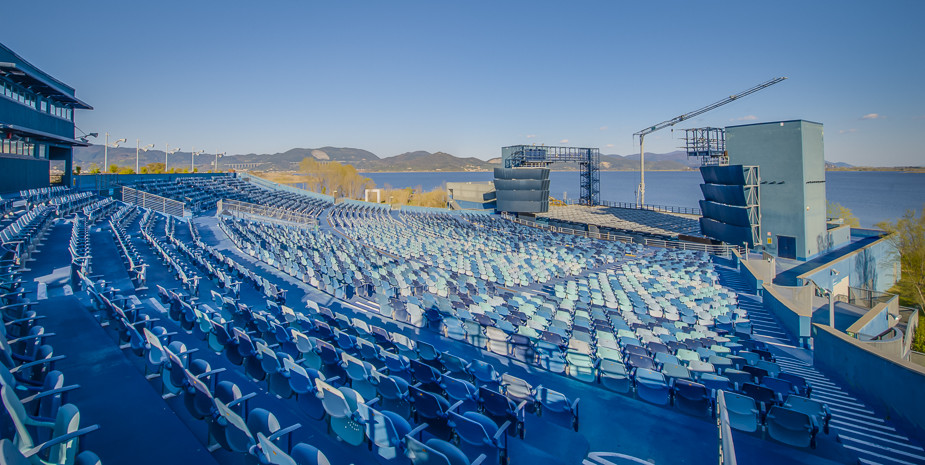
The Festival Puccini (puccinifestival.it. July–August, approximately 20 performances over 5 weeks): the festival stages Puccini's operas on the Grand Teatro Giacomo Puccini, a floating stage platform on Lake Massaciuccoli constructed annually at the lakeside in front of the Villa museum. The stage: the specific design (the stage extends over the lake, the audience sits on the shore facing the water, the lake and the Versilia coast visible behind the staging) produces the most specifically atmospheric opera setting in Italy, the Tosca Act II dawn, performed with Lake Massaciuccoli visible above the stage, is the most historically resonant production context in Italian opera. The repertoire: the festival rotates through Puccini's major works. Tosca, La Bohème, Madama Butterfly, Turandot are the most frequently presented, with La Fanciulla del West and the one-act operas (Il Trittico, the three one-act operas, Il Tabarro, Suor Angelica, Gianni Schicchi) in the rotation. Ticket prices: €25 (gallery) to €160 (front stalls), available at puccinifestival.it from April.
When is the Puccini Festival at Torre del Lago?
The Puccini Festival (puccinifestival.it) takes place July–August annually at Torre del Lago Puccini (Viale Kennedy, the lakeside site adjacent to the Villa museum). The festival runs approximately 20 opera performances over 5 weeks. The Grand Teatro Giacomo Puccini is a temporary floating stage built annually over Lake Massaciuccoli. Ticket prices: €25–160 depending on seating category. Available online from April at puccinifestival.it. Getting there: Torre del Lago is accessible from Pisa by regional train to Viareggio (20 minutes, €3.50) then bus or taxi (3km). Or directly by car from Via Aurelia coastal road. Accommodation: Viareggio (7km, the Art Nouveau Tyrrhenian resort town) has the most convenient hotel accommodation for the festival. Torre del Lago itself has limited accommodation. Post-festival villa museum visit: the Villa Puccini museum (villapuccini.it, €10) is open during the festival period, combining the villa visit with the evening performance provides the most complete Puccini context.
Puccini's Tuscany: The Complete Circuit
The complete Puccini Tuscany circuit, the locations connected to the composer's life and work: Torre del Lago (the Villa museum, the lake, the festival venue, the primary site).Lucca (Puccini's birthplace, 25km from Torre del Lago, the Casa natale di Giacomo Puccini, Corte San Lorenzo 9, €7, the most complete documentation of his early life and the Lucca musical tradition that produced him. The Lucca Puccini Foundation also presents an annual autumn Puccini concert series in the historic churches).Viareggio (the Tyrrhenian resort town adjacent to Torre del Lago, where Puccini frequented the café on the promenade, the Caffè Margherita, now a bar-gelateria (ice cream shop) at the same Viareggio seafront location, maintaining the connection). And Milan (La Scala, where most of Puccini's premieres took place, including the catastrophic first Butterfly). Related: Tuscany guide.
Plan Your Puccini Festival Visit
Festival ticket booking from April, Villa Puccini museum advance booking, Viareggio accommodation for July–August, and the Lucca Casa Natale Puccini visit schedule.
Vittoria Puccini , actress, at 81st Venice International Film Festival in Venice, Italy · photo LucaFazPhoto · CC BY-SA 4.0 · via Wikimedia Commons
Italy's UNESCO Intangible Cultural Heritage: What Gets Recognised and What It Means
UNESCO's Intangible Cultural Heritage list (the ICH list, established by the 2003 Convention for the Safeguarding of the Intangible Cultural Heritage, the companion to the World Heritage material culture list) recognises cultural practices, expressions, and traditions rather than buildings or landscapes. Italy has 18 elements on the ICH list, the most of any western European country. The most significant:
Opera lirica (2023, the most recent Italian ICH designation): The Italian lyric opera tradition, recognised for its extraordinary range of emotional expression, the specific vocal technique traditions (the bel canto, the dramatic soprano and tenor traditions of the 19th-century repertoire), and the social function of opera in Italian civic life (the opera house as a community space, as described in the San Carlo and Maggio Musicale guides). Neapolitan Tailor Art (2023): The Neapolitan tailoring tradition (described in the tailoring experience Naples guide), the first fashion craft designated UNESCO ICH from Italy. The Mediterranean Diet (2013): Designated jointly by Italy, Spain, Greece, Morocco, Portugal, Croatia, and Cyprus, the dietary pattern as cultural practice rather than as nutritional science. Falconry (2016, joint with 18 countries): The traditional practice of training raptors for hunting. Italy has the Rete Italiana Falconeria, the oldest continuous European falconry association. Art of Neapolitan Pizzaiuolo (2017): The specific craft of making pizza napoletana, the throwing, the shaping, the wood-fire technique, as a living cultural practice transmitted through generations of Neapolitan pizzaiuoli. Violin Craftsmanship in Cremona (2012): The Cremona luthier tradition described in the violin making guide. The ICH list represents a significant expansion of UNESCO's definition of what is culturally worth protecting, from buildings to practices, from monuments to skills.
What Italian traditions are UNESCO Intangible Cultural Heritage?
Italy's UNESCO Intangible Cultural Heritage designations include: Opera lirica (2023. Italian lyric opera tradition). Neapolitan Tailor Art (2023, the sartoria napoletana craftsmanship). Art of Neapolitan Pizzaiuolo (2017, the specific pizza-making craft). Violin Craftsmanship in Cremona (2012, the Cremona luthier tradition). Mediterranean Diet (2013, shared with 6 other countries). The Mele di Dolo polyphonic singing (Veneto, 2018). And 12 additional Italian elements including the Colata dei Candelori processional tradition (Nola, Campania), the Ndocciata fire festival (Agnone, Molise), and the Sartiglia equestrian festival (Oristano, Sardinia). Italy's 18 ICH elements is the largest number in western Europe, reflecting both the depth of Italian traditional culture and the Italian government's active ICH nomination program.
Italy's Salt Flats and Salterns: The Most Underrated Italian Natural Heritage
Italy has surviving salt production salterns (saline) that are simultaneously extraordinary landscapes, working historical industrial heritage, and important bird habitats:
Saline di Trapani e Paceco (northwest Sicily): The most extensive and most historically significant Italian salterns. 1,000+ hectares of evaporation ponds on the Sicilian coast between Trapani and Marsala, with the specific pink-to-white color gradient of the salt crystallising in the ponds (the color produced by the Halobacterium salinarium, the halophilic archaea that metabolise in the brine and produce the carotenoid pigments that color the water orange-pink in specific concentration conditions). The Museo del Sale (the Salt Museum, Via Chiusa, Nubia locality, free entry, Tuesday–Sunday 9am–1pm and 3–7pm) documents the traditional Sicilian salt production in the windmill-driven pumping infrastructure. The windmills (the 400-year-old grinding and pumping windmills on the saltern causeways, partially restored and maintained as working heritage) are the most photographed Trapani landscape element. The flamingo colony (Phoenicopterus roseus, the greater flamingo, which has bred at the Saline di Trapani since 1996, the only Sicilian breeding flamingo colony) is present from March to October, visible at dawn from the causeway walking path. Saline di Cervia (Ravenna province, Emilia-Romagna): The most complete medieval-plan saltern in Italy, the Cervia salt pans have been continuously operated since the 10th century, with the specific San Vito layout (the grid of evaporation ponds extending inland from the Adriatic) preserved intact. The Cervia salt (Sale di Cervia, the most celebrated Italian artisan sea salt, harvested once per year in late August/September, unrefined, moist, the specific mineral composition of the Adriatic coastal brine, available at the Magazzino del Sale in Cervia at €4–8/kg) is the most specifically valued Italian culinary salt. The harvest period (August 25–September 10 approximately) is the most photographically and experientially rewarding visit window: the salt harvest combines the geological spectacle of the crystallised salt beds with the traditional equipment and the specific labour of the salters.
What are Italy's best salt flats to visit?
Italy's most significant salt flats: Saline di Trapani e Paceco (northwest Sicily. 1,000+ hectares, the most extensive, the flamingo colony, the windmill heritage, Museo del Sale free, the most photogenic Italian saltern). Saline di Cervia (Romagna Adriatic, medieval-plan salterns, the most celebrated Italian artisan salt, harvest festival late August, Magazzino del Sale shop). Laguna di Orbetello (Tuscany Maremma, the coastal lagoon with salt flats and flamingos, the Maremma nature reserve birds, accessible from Albinia). And the Saline di Margherita di Savoia (Puglia Adriatic, the most productive Italian saltern, 3,800 hectares, the largest saltern in Europe by area, the pink flamingo colony, the salt museum, accessible from Foggia). All are accessible by car. Most have free public walking access to the perimeter causeways.
Villa puccini di torre del lago · photo sailko · CC BY-SA 3.0 · via Wikimedia Commons
Italy's Extraordinary Lighthouses: The Coastal Navigation Heritage Still in Use
Italy's lighthouse heritage (fari, the coastal lighthouses, built primarily in the 19th century under the unified Italian state's coastal navigation program) includes some of the most dramatically positioned coastal structures in the country, most of them still operational:
Faro di Capo Spartivento, Sardinia (Chia): The most visually isolated lighthouse on the Sardinian south coast, a 19th-century stone tower on the headland above the Chia beaches, 45m above the sea, with the Tyrrhenian to the west and the lighthouse garden as the most secluded elevated position on the south coast. The lighthouse is now a boutique accommodation property (Faro di Capo Spartivento, farocapospartivento.com, the most extraordinary Italian lighthouse hotel conversion, from €400/night). The exterior is accessible on foot from the Chia beach car park (30-minute walk). Faro della Guardia, Capri: The Guardia lighthouse at the south tip of Capri (accessible on the 2-hour coastal walk from Anacapri, the most remote Capri point, past the Villa Damecuta Roman ruins) is the most dramatically positioned Italian lighthouse visible from the sea. Not accessible to the public at the tower itself (active lighthouse, Italian lighthouse authority management), but the approach walk provides the finest Capri cliff experience available without a boat. Faro di Punta Carena, Elba: The most visited lighthouse on Elba, the Punta Carena lighthouse at the southwest cape is accessible by road and provides the most dramatic Elba headland swimming at its base (the lighthouse rocks below Punta Carena, described in the best beaches Elba guide, are accessible by the concrete path from the lighthouse car park). The lighthouse restaurant (adjacent to the tower) serves the freshest fish on Elba at specific tables on the rock platform above the sea. The sunset at Punta Carena (facing west, the sun descending into the Tyrrhenian, the Corsica silhouette visible on clear days, approximately 35 minutes of golden hour from the lighthouse platform) is the most celebrated Elba evening event. Open daily from 7pm in summer. Arrive by 7:30pm for table availability.
Can you visit Italian lighthouses?
Italian lighthouse access varies: most active Italian lighthouses (fari attivi, managed by the Marina Militare lighthouse authority, www.marina.difesa.it/fari) aren't publicly accessible at the tower itself. The lighthouse grounds and the coastal approach paths are typically publicly accessible. Some Italian lighthouses have been converted to accommodation (Faro di Capo Spartivento Sardinia. Faro di Bibione Veneto. Faro di San Vito lo Capo Sicily, all boutique hotels with lighthouse character). The most dramatic publicly accessible lighthouse viewpoints: Punta Carena lighthouse Elba (restaurant on the rock platform, the best Elba sunset, accessible by road). Capo Testa lighthouse Santa Teresa Gallura Sardinia (30-minute walking trail from the Capo Testa car park, the most extraordinary north Sardinia granite landscape). And the Capo Colonna lighthouse near Crotone, Calabria (the most historically significant – on the headland where the Temple of Hera Lacinia stood, one column still standing adjacent to the lighthouse site).
Plan the rest of your Italy trip
The essentials, compared and booked with the official sellers. Same price for you. We may earn a commission.
Italy How do you want to travel?
Tours & experiencesGYG · Viator
Top things to do in Italy, compared across sellers