Sicily is the island where Greek myths, Arab beliefs, Norman Catholicism, and Sicilian popular syncretism have mixed for 3,000 years, creating a layer of legends with few equivalents in the world. Every mountain, every quarry, every sea has its own story. Some are "officially" mythology. Others are still told by the old folk of the villages as things that happened.
How do you want to see it?
Sicily, ItalyCompare the same experience on GetYourGuide and Viator, save what you like to My Trip, share it, and book when you’re sure. Nearest to this page first.



The Cyclops of Acireale: Greek mythology in the real landscape
The Faraglioni of Aci Trezza (CT), three rocks of lava basalt rising from the sea a few meters from the shore, are traditionally identified as the boulders the Cyclops Polyphemus hurled at Ulysses in Book IX of Homer's Odyssey. Eastern Sicily is the territory where the Odyssey is geographically set: Ulysses is said to have landed near Etna (the land of the shepherd Cyclopes), blinded Polyphemus in the cave (the Cyclops lava caves of Aci, visitable today), and fled while the boulders fell into the sea. The correspondence between the Homeric text and the geology of the place has been studied by academics, the boulders of the Faraglioni are geologically analogous to the description of the Cyclops's projectiles.
The Fata Morgana of the Strait of Messina
The Fata Morgana is an optical phenomenon, a form of catadioptric mirage, that rarely appears in the Strait of Messina: the Calabrian coast seems to multiply into superimposed layers, with floating castles and cities suspended over the water. The phenomenon is real and scientifically documented, it occurs when layers of air of different temperature above the water of the Strait reflect light anomalously. The name comes from the Fata Morgana (Morgan le Fay of the Arthurian cycle) whom medieval Sicilian legends placed in the Strait of Messina as a sorceress who deceived sailors with visions of fantastic castles to make them crash on the rocks.

Etna in mythology: Hephaestus, Typhon, and the Giants
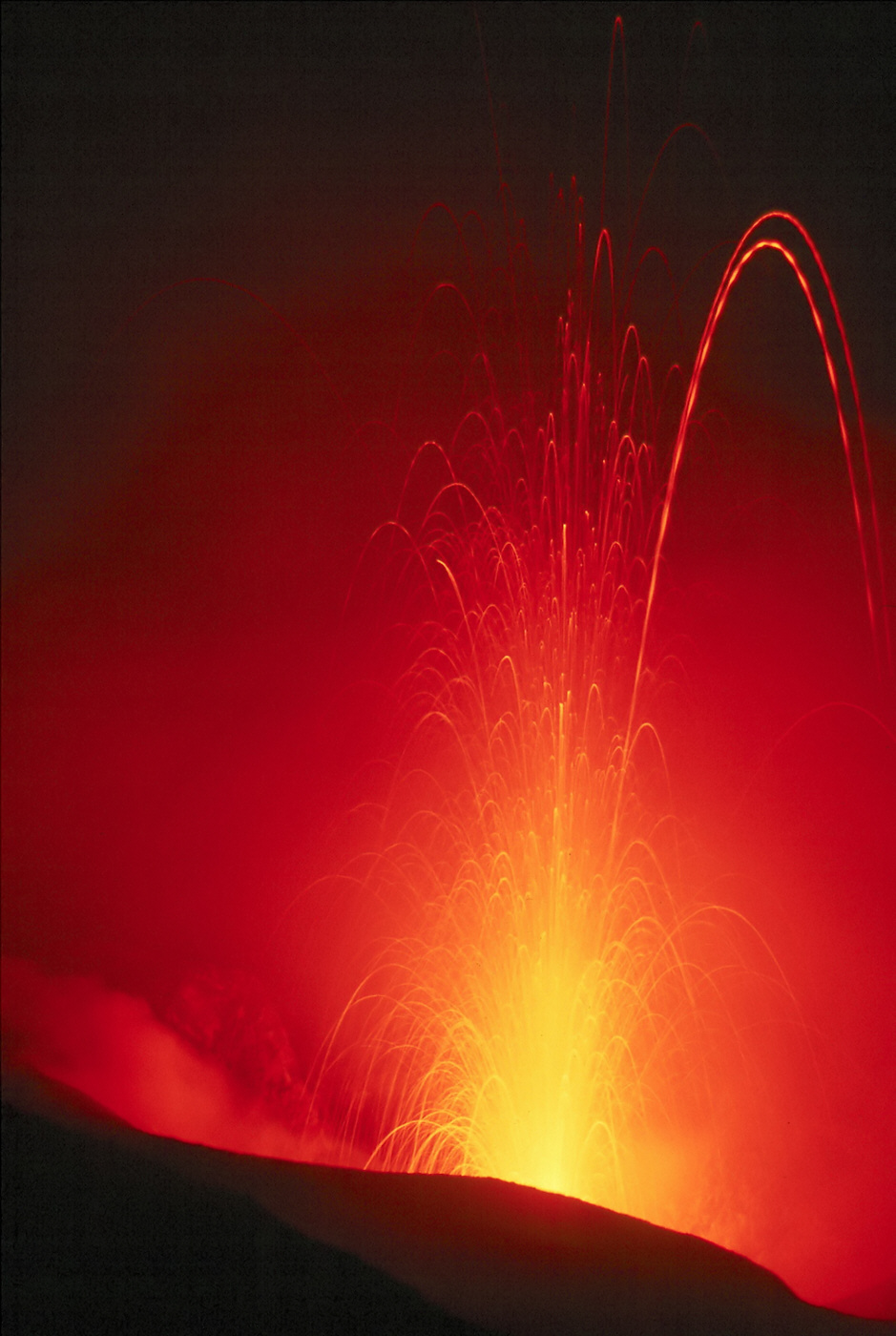
Etna is the most mythologically rich volcano in Europe. In the Greek version: it is the forge where Hephaestus (Vulcan to the Romans) forged the weapons of the gods, helped by the Cyclopes. The eruptions were the smoke of the forges. In the alternative version: the Titan Typhon, the largest monster ever born of Gaia, is imprisoned under Etna by Zeus after the last battle between gods and Titans. Every eruption is Typhon trying to free himself. In the Roman version: Enceladus, one of the Giants defeated by Athena in the Gigantomachy, is buried alive under Sicily, the eruptions are his burning breath, the earthquakes his movements. The Latin poetic tradition (Virgil, Ovid, Horace) uses Etna as a metaphor for chaos and untamable nature.
The cult of Saint Rosalia and the end of the Plague of Palermo (1624 to 1625)
Saint Rosalia is the patron of Palermo, a story that mixes real history, mystical visions, and city politics. The real Rosalia (around 1130 to 1166) was a Norman noblewoman who left the court of Roger II to live as a hermit in the caves of Monte Pellegrino above Palermo. The legend: in 1624, Palermo was devastated by the Plague. In 1625, a sick man had a vision of Rosalia showing him her relics under Monte Pellegrino. The procession with the relics through the streets of Palermo brought the end of the pestilence in 1626. Since then, the Festino di Santa Rosalia (14 to 15 July) is the most important festival in Palermo, a monumental allegorical float travels the city streets followed by hundreds of thousands of people. The cave on Monte Pellegrino where Rosalia lived has become a sanctuary: visitable all year, with the water dripping from the cave walls (considered miraculous by the faithful).
The Trinacria: the Sicilian symbol with the head of a Gorgon
The symbol of Sicily, the Trinacria, is a Greek-Sicel symbol: a head of Medusa at the center with three bent legs rotating around it (the three capes of the island: Capo Peloro, Capo Passero, Capo Lilibeo). The Trinacria appears on Sicel coins of the 4th and 3rd century BC and today stands on the Sicilian regional flag. The central head is Medusa (or Demeter, according to an alternative interpretation), with grain in her hair instead of the serpents of the archaic version. The three-sided symbol (three = triangle = stability) with circular movement around the center was used in many cultures of the ancient Mediterranean to represent the eternal cycle of the seasons.
The Beati Paoli: the medieval sect of Palermo
The Beati Paoli are a Palermo legend, or perhaps a historical reality, the line isn't clear. According to popular tradition (and a 1909 historical novel by Luigi Natoli that made the myth famous): the Beati Paoli were a secret sect of Palermo of the 17th and 18th centuries, that met in the catacombs under the city (still visitable under the church of Santa Maria di Gesù) to judge and punish the nobles who oppressed the people. A kind of collective Sicilian Robin Hood, with nighttime execution as an instrument of justice. Historians have found no documentary proof of the organized existence of the Beati Paoli, but the catacombs are there, the nighttime meetings of religious-political brotherhoods were common in the Spanish era, and the legend shaped the Sicilian myth of secret resistance to the oppressor, with cultural consequences that reach as far as the modern Mafia.

Questions and answers about Sicilian myths and legends
Sicily myths: does the Mafia have mythological or historical origins?
The Sicilian Mafia (Cosa Nostra) has historical origins documented in the 19th century, not mythological. The most accepted theory: the Mafia arose in the 1800s as a system of private protection in the Sicilian countryside during the power vacuum following the Unification of Italy (1861), when the Savoy state failed to control the territory. The "gabelloti," managers of the large landed estates, built networks of violent protection that gradually became autonomous. The word "mafia" appears for the first time in official documents in 1865. The link with the Beati Paoli is a romantic narrative construction, the Mafia is a modern criminal organization, not a medieval sect of avengers.
Sicilian legends: is Etna really active and dangerous for tourists?
Etna is the highest active volcano in Europe (3,326 m) and one of the most active in the world, eruptions of varying intensity occur every year. For tourists: the routes up to 2,900 m (accessible by cable car from Nicolosi and then minibus) are monitored by the INGV (National Institute of Geophysics and Volcanology) and closed automatically in case of high activity. In normal conditions, the visit to the summit crater zone is safe but physically demanding (high altitude, unstable lava terrain). The inhabited area at the foot of Etna (Catania, Nicolosi, Randazzo) isn't in immediate danger even during normal eruptions, the lava flows slowly and the paths are predictable. The last case of significant residential evacuation: the 2002 flow toward Linguaglossa (ME).
Guide collegate su ItalyPlanner.com
Sicilia: guida completa Rovine antiche italiane Misteri italiani Grotte d'Italia Quando visitare la Sicilia Road trip Sicilia Isole vulcaniche italiane Nuraghi della SardegnaThe places in Sicily most charged with mysterious history
The Valley of the Temples of Agrigento (AG) has an unsolved mystery: the Greek temples of the 5th century BC are among the best preserved in the world, but not because the Sicilian territory protected them (there were earthquakes, lootings, vandalism). What saved them was their conversion into Christian churches in the Middle Ages, the Temple of Concordia became a church in the 6th century AD, preserving the structure. The Rupe Atenea above Agrigento has prehistoric caves with petroglyphs not yet fully deciphered. The Lake of Pergusa (EN), the only natural lake in Sicily, is in Greek mythology the place where Hades abducted Persephone (Kore) taking her to the Underworld: the lake is described in the Homeric Hymn to Demeter as a "meadow of flowers" where Persephone was gathering flowers when she was abducted. Sicily as the gate of the Underworld, the tradition persists in the local festivities of Enna dedicated to Demeter.

Frequently asked questions on this topic in Italy
How to book the main Italian attractions in advance without queues?
Advance booking is essential for the big Italian sites in high season. The official sites: the Colosseum (www.coopculture.it), the Vatican Museums (www.museivaticani.va), the Uffizi and the Accademia (www.uffizi.it), the Galleria Borghese (www.galleriaborghese.it, booking required, entry only by appointment). By booking 2 to 4 weeks ahead, at all these sites you save 1 to 3 hours of queuing. The booking fee (€2 to €5 per ticket) is the best investment of a trip to Italy. Useful app: GetYourGuide and Tiqets have tickets with priority access for many sites, including the guide, convenient if you don't speak Italian.
Is Italy suitable for vegetarian, vegan, or food-allergic travelers?
Vegetarians: yes, Italy has ample options, pasta with tomato, pesto, lemon, the pizzas without meat, the grilled vegetables are on any menu. Vegans: harder in the traditional areas (butter and parmigiano enter many dishes as a hidden ingredient), the big cities (Milan, Rome, Bologna, Florence) have dedicated vegan restaurants. Gluten-allergic: celiac disease is well recognized in Italy, many restaurants have gluten-free menus (AIC, the Italian Celiac Association, certifies restaurants that are safe for celiacs). Allergic to nuts or peanuts: be careful with Italian sweets (torrone, baci di Alassio, panforte) and mixed condiments, always ask for specific ingredients.
How to get around Italy with small children, is it family-friendly?
Italy is one of the most child-friendly destinations in Europe for culture and food, Italians genuinely adore children and restaurants welcome families with no problem even in the evening. The practical challenges: strollers in the historic cities (cobbles, steps, no elevator in the older metros), the walking distances between sites, the summer heat in the cities. Solutions: a baby carrier instead of a stroller in the historic centers, an early morning start, an afternoon rest (it coincides with the Italian siesta), cultural sites that are alternatives to museums for children (parks, markets, gelato as an Italian cultural experience).
Italy: useful facts every traveler should have
- Emergencies: 112 (single EU number for all emergencies), 113 (Polizia di Stato), 115 (Fire brigade), 118 (Medical emergency)
- Opening hours: shops typically 9:00 to 13:00 and 15:30 to 19:30, restaurants open 12:30 to 14:30 (lunch) and 19:30 to 22:30 (dinner), museums usually closed on Monday
- Tipping: not required in Italy, the service is included in the coperto (€1 to €3 per person). Rounding up the bill or leaving €1 to €2 per person for excellent service is appreciated but not expected
- Electricity: 220V, 50Hz, type F (twin) and type L (Italian three-pin) sockets
- Tap water: drinkable throughout Italy, save plastic with refillable bottles
Final tips and curiosities about Italy that change how you experience it
Italy has 58 UNESCO World Heritage Sites, the highest number in the world ahead of China (57). They aren't all famous: many people know the Colosseum and Venice, very few know that Monte San Giorgio (the Italy-Switzerland border, Varese) is UNESCO-listed for the Triassic marine fossils from 230 million years ago, the most important paleontological site in Europe for that period. That the Rhaetian Railway (the panoramic Bernina train) is UNESCO-listed in part on the Italian side (Tirano, SO). That the Medici Villas and Gardens in Tuscany are 14 separate villas inscribed together in 2013. That the civilization of the Langhe (Piedmont, the territory of Barolo and Barbaresco) is UNESCO-listed for the Cultural Landscape of the Langhe-Roero and Monferrato since 2014. The Italian UNESCO heritage is so abundant that many sites are practically unknown even to experienced travelers.
How does Italy manage overtourism in the most crowded destinations?
Overtourism is the most serious problem of Italian tourism in the 2020s. The measures adopted or under discussion: Venice introduced the daytime entry ticket (€5) on peak days from 2024, applied to non-overnight visitors between 10:00 and 16:00, the Cinque Terre require booking the main trails in high season, Rome is discussing access limits to the Trevi Fountain in the central hours, Portofino has set a maximum number of cars entering. The trend is toward more active flow management, those who arrive in the peak hours on high-season weekends will find growing regulated-access systems. How to avoid the problem: travel in the shoulder seasons (April to May, September to October), choose weekdays for visits to the most crowded sites, arrive at opening (9:00) or in the late afternoon (16:30 to 18:30).
Do you need Italian to visit Italy? How many languages are spoken?
Italian is the official language and necessary for any interaction outside the main tourist areas. English is spoken in the big cities and tourist zones, at a level sufficient for basic transactions (hotels, restaurants, museums, transport). Outside the tourist areas (villages, countryside, towns of the South) English is rare among the over-40s. Basic Italian (grazie, per favore, buongiorno, quanto costa, posso avere..., dov'è...) solves 70% of situations. The Italian linguistic minorities with official recognition: German in Alto Adige (all the signs are bilingual), Slovenian in Friuli-Venezia Giulia, French in the Aosta Valley, Ladin in the Dolomite valleys, Sardinian in Sardinia. The Sicilian, Neapolitan, and Venetian dialects are so different from standard Italian that even northern Italians sometimes struggle to understand them, let alone foreign tourists.